

Smarter winter care for ultradwarf bermudagrass: two winters of soil sensor data under covers
October 16, 2026
By Travis Roberson, Ph.D., technical services field manager for Syngenta Digital Platforms
Key Takeaways: Your Winter Protection Plan
- Proactive cold-weather tracking: Pair Spiio™ GCX soil sensors and GreenCast® Connect to receive automated freeze alerts to safeguard turf throughout freeze events.
- 25°F cover threshold: Receive forecast-based alerts to time green cover installation ahead of critical cold snaps.
- Crown and root protection: Go beyond air temperature—monitor soil temperatures to verify your covers are truly insulating the plant.
- Detect sub-surface freeze onset: A sudden drop in soil moisture signals that root-zone pore water is freezing, providing an immediate early warning beneath the surface.
- Track snow insulation in real time: Snow often acts as an insulating layer. GreenCast Connect pairs forecasts with live soil data to reveal actual conditions beneath the surface.
Ultradwarf bermudagrass is becoming a more established choice in the southern U.S. and transition zone. Improved varieties provide high-quality putting surfaces under intense heat and traffic, encouraging turfgrass managers to adopt it in northern climates for superior summer performance. However, in these northern climates, ultradwarf bermudagrass is susceptible to winter injury from extended exposure to low temperatures that compromise key plant components.
Winter Protection: Why Covers Matter
The primary way to protect ultradwarf bermudagrass greens is with black polypropylene covers, which elevate soil temperatures within the top subsurface of the soil, protecting the crown of the plant. Covers are recommended when air temperature is predicted to drop below 25°F – a balance between risk prevention and revenue loss. The decision is made on air temperature, but the plant responds to soil temperature at the crown.
Using Soil Sensors for Informed Decisions
A trial on Green 4 at a golf club in Midlothian, Virginia during the 2024-2025 and 2025-2026 winters compared three treatments each replicated four times in a randomized complete block design:
- No cover (NC)
- A single polypropylene cover (SC)
- A double cover (DC)
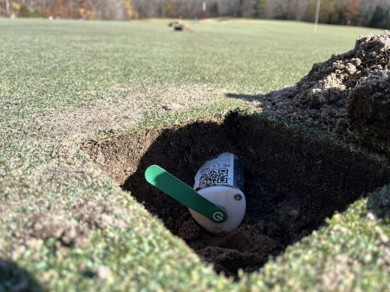
One Spiio GCX soil sensor at the center of each plot (Figure 1) recorded soil temperature, moisture and salinity hourly alongside an on-site Davis® weather station. Covering events followed the course’s 25°F guideline. This article focuses on the coldest event of each winter: the 23-day January 2025 event and the 31-day January-February 2026 event, during which air temperature fell to absolute minimums of 6.8°F and 3.2°F, respectively – the lowest recorded during any covering event across both winters.
Soil Temperature Response to Covering
January 2025:
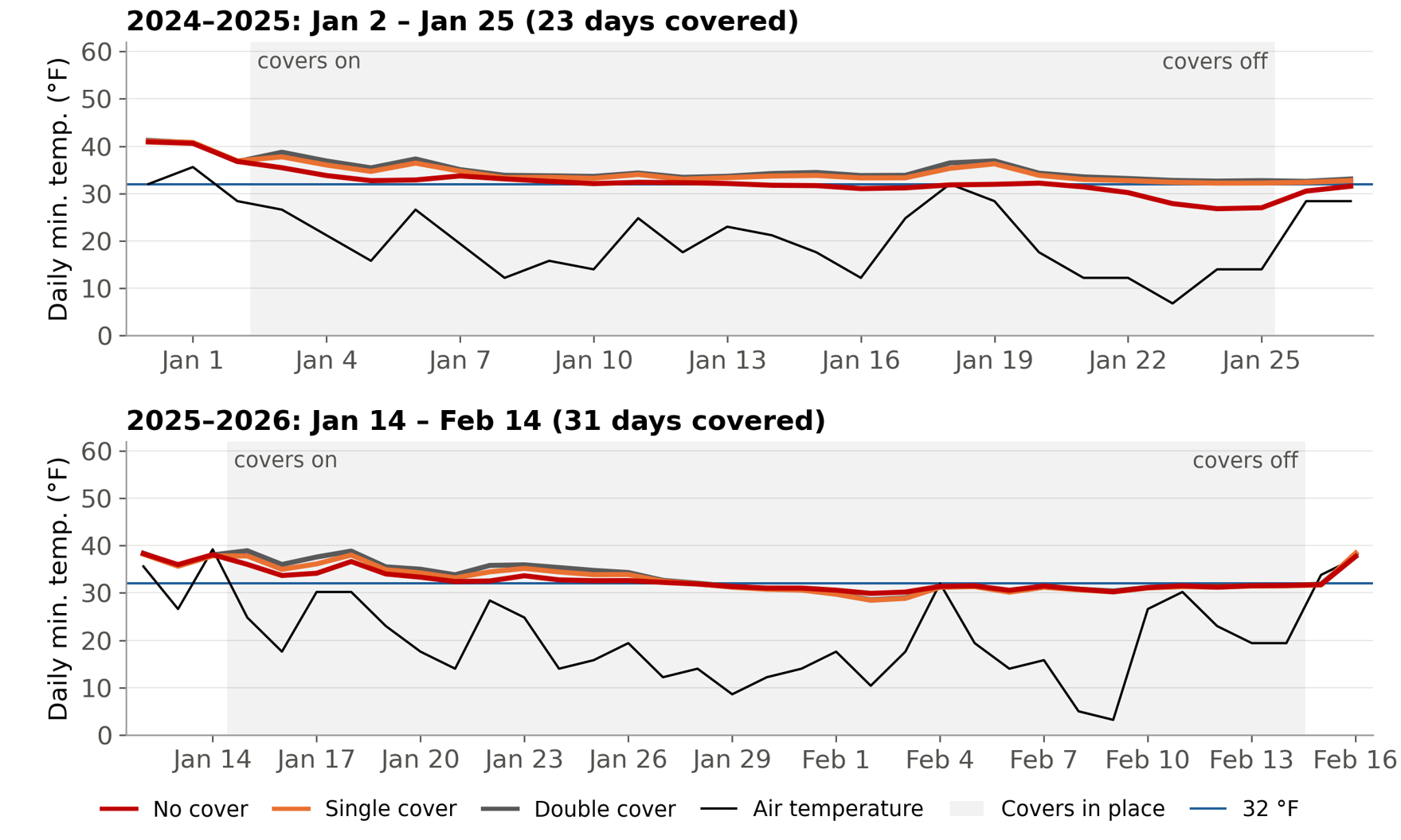
- The SC and DC treatments never fell below 32°F (minimums of 32.2°F and 32.6°F).
- The NC treatment dropped below freezing around January 21, reached 26.8°F on January 24 and spent 196 hours below 32°F, remaining frozen for two days after covers were removed on January 25 while the SC and DC plots warmed.
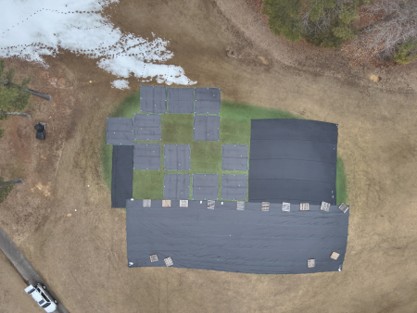
- On January 19 (Figure 2), NC soil was 31.9°F versus 36-37 °F under covers.
January-February 2026:
- For the first ten days, SC and DC soil temperatures were 2-4°F warmer than NC.
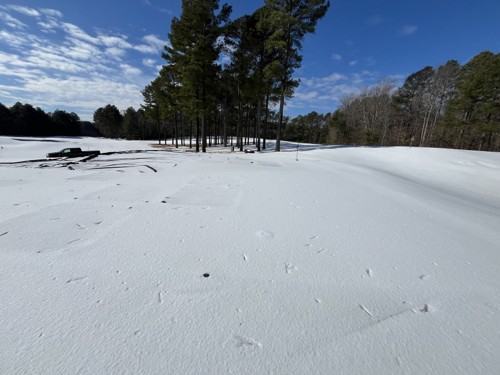
- On January 25, heavy snowfall set into an ice cap that did not melt until February 11 (Figure 3). The extended snow pack then effectively neutralized the soil temperature preservation provided by the covers. Within 48 hours the separation collapsed, and for 19 consecutive days (January 27-February 14) the SC and DC treatments held no measurable advantage over NC.
- All treatments tracked the same 30-32°F floor set by the snow pack; when air temperature fell to its absolute minimum of 3.2°F on February 9, soil under all three was 30-31°F. Each treatment recorded roughly 400 hours below 32°F, with minimums of 29.9°F (NC) and 28.4-28.6°F (SC and DC).
Soil Moisture Response to Covering
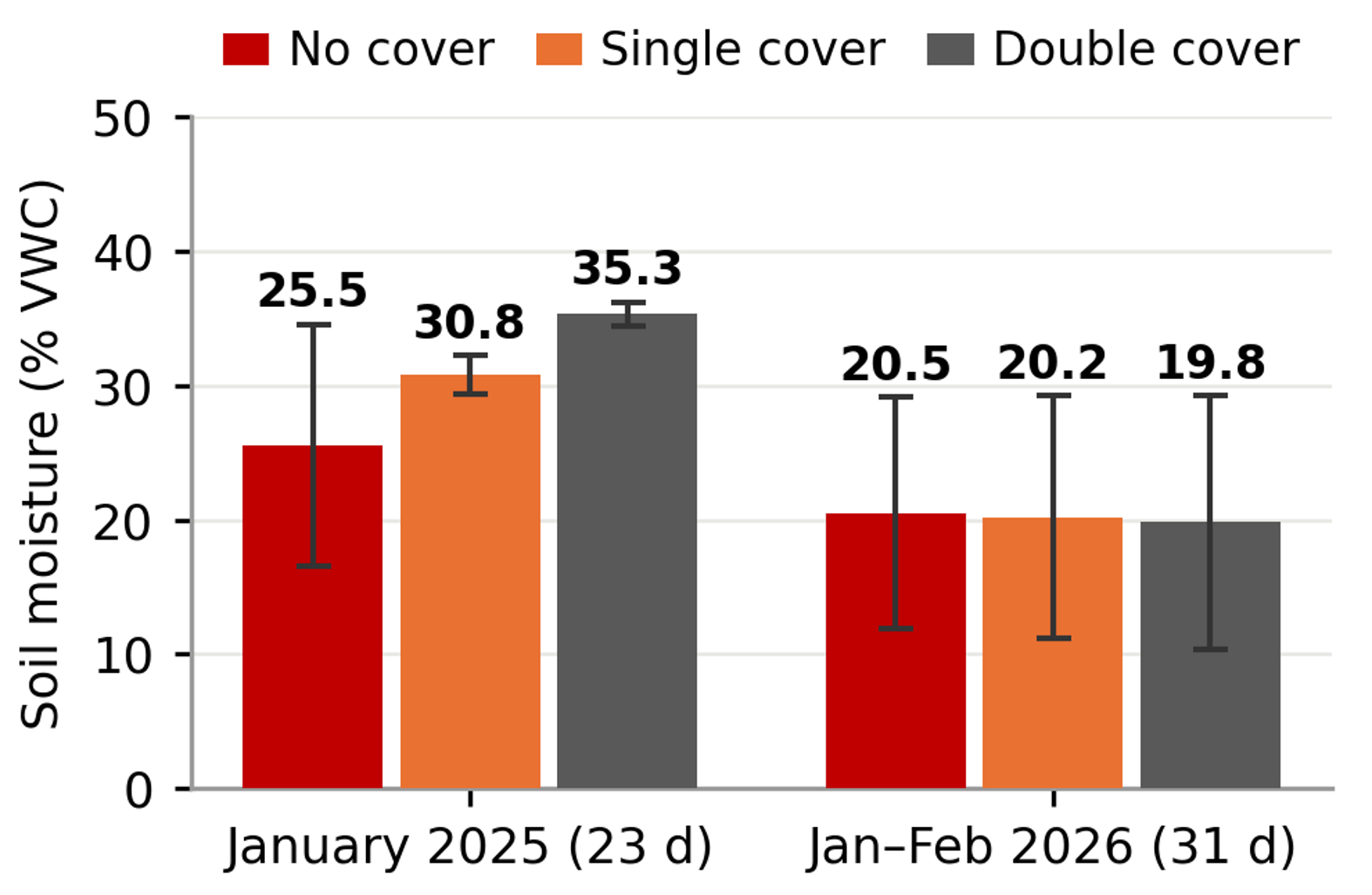
Soil moisture confirmed the temperature response (Figure 5). Readings fell by about 20 percentage points only in plots where the soil froze: NC in January 2025 and all three treatments under the 2026 snow cap. The readings then recovered within one to two days of thaw. This reflects frozen pore water, not water loss. The Spiio GCX soil sensor reads liquid water, so a sudden decline signals a frozen root zone. In January 2025, NC averaged 25.5% volumetric water content while SC and DC held steady at 30.8% and 35.3%; in 2026, all three averaged approximately 20%.
Turf Response
Neither cold event produced meaningful winterkill. NC plots showed delayed greenup in spring 2025 but recovered by summer; in spring 2026, greenup differences among treatments were minimal.
Implications For Management
- Air temperature indicates when to cover; soil temperature indicates whether covering is working. The 25°F guideline timed covers correctly in both winters, but air temperature alone could not show that the NC root zone froze in 2025, or that no treatment fell below 28°F under the 2026 snow while air reached 3°F (Figure 4).
- Covers provide a 2-4°F root zone advantage in open cold conditions, keeping SC and DC above 32°F through the 6.8°F absolute minimum in January 2025. The second cover layer added less than 1°F.
- Under an extended snow pack, covers provided no preservation of soil temperature mitigation. During the two- to three-week snow pack period in 2026, SC and DC soil temperatures were no different from NC.
GreenCast Connect
GreenCast Connect provides accurate above- and below-ground insights for managing ultradwarf bermudagrass greens in winter. Spiio GCX soil sensors report soil temperature and moisture alongside precise weather data. Users can set soil temperature alerts – this trial supports 32°F at the root zone – before, during and after covering events, while the Severe Weather Monitor tracks forecasted severe cold and snow cover. Learn more at GreenCastConnect.com.
References:
- DeBoer, E. J., M.D. Richardson, J.H. McCalla, and D.E. Karcher. 2019. Reducing ultradwarf bermudagrass putting green winter injury with covers and wetting agents. Crop, Forage & Turfgrass Mgmt. 5:190019.
- DeBoer E.J., D.E. Karcher, J.H. McCalla, and M.D. Richardson. 2020. Effect of late-fall wetting agent application on winter survival of ultradwarf bermudagrass putting greens. Crop Forage & Turfgrass Mgmt. 6: e20035.
- Goatley, J.M., Jr., J.P. Sneed, V.L. Maddox, B.R. Stewart, D.W. Wells, and H.W. Philley. 2007. Turf covers for winter protection of bermudagrass golf greens. Applied Turfgrass Science. 4:1–9.
- O'Brien, P. and C. Hartwiger. 2013. Covering guidelines for ultradwarf bermudagrass putting greens. USGA Green Section Record. January 9. 51(1).
All photos are either the property of Syngenta or are used with permission.
© 2026 Syngenta. GreenCast® and the Syngenta logo are trademarks of a Syngenta Group Company. Spiio™ is a trademark of Spiio, Inc. All other trademarks are the property of their respective third-party owners.